
Explore a real example
Bring one completed or ongoing industrial project, along with whatever reports, emails, and informal notes you have, and we will explore how to turn it into a calm, structured reference point for future decisions.
If you have a past decision that still raises questions, we can start with a brief
conversation using your existing documents and memories, then outline how a structured
hindsight review might look for your organisation.
Start a review
How a hindsight review unfolds

1
Rebuilding the story
We begin by gathering the original project materials and creating a concise narrative of the decision. This includes the stated purpose, the key figures used to justify the choice, and any explicit caveats recorded at the time. Where documents are silent, we supplement with interviews, asking participants how they remember the discussion. The goal is to reconstruct the decision as it was genuinely understood, not as it might be retold with hindsight. This narrative becomes the anchor for all later comparison work.
2
Three lenses in hindsight
Next, we apply a hindsight version of the Three Lens Review. Operational resilience is examined by mapping real incidents, maintenance events, and production shifts against the original expectations. Capital structure is reviewed through the actual behaviour of funding arrangements during calm and strained periods. Scenario stress is revisited by asking which unanticipated events had the greatest impact. Throughout, we remind participants that results may vary and that past performance does not guarantee future results, to keep the tone exploratory rather than accusatory.
Mapping variance constructively
With the lenses applied, we move into Baseline to Variance Mapping. Here we select a small set of anchor metrics from the original narrative and compare them with current and historical data. Where variance is significant, we ask a series of structured questions: Is this change temporary or persistent? Does it stem from internal decisions, external shifts, or both? Which early indicators, if monitored, might have signalled this movement sooner? The aim is not to grade the original team, but to understand the mechanics of divergence in your specific industrial context.
Distilling lessons for next time
Finally, we distil the review into a short set of transferable notes. These notes focus on patterns that are likely to recur across future projects: common blind spots, useful early indicators, and governance practices that either helped or hindered adaptation. We avoid sweeping declarations and instead offer measured observations that can inform board materials, internal guidelines, and everyday conversations about capital and risk in your Canadian operations.

Looking back without getting stuck
This page explores how you can turn past industrial finance decisions into practical
reference points, using structured reflection rather than blame to guide future capital
and risk conversations.
What you explore when revisiting industrial finance decisions
-
Reconstructing the original decision context carefully: We begin by reframing completed projects as living case notes rather than closed files. Together we reconstruct the original intent, the key anchors that supported approval, and the context in which decisions were made. This reconstruction is not about nostalgia. It provides a stable reference point against which later events, data, and surprises can be compared in a measured way.
-
Reviewing outcomes through three parallel lenses: Next, we adapt the Three Lens Review for hindsight. Operational resilience, capital structure, and scenario stress are revisited with the benefit of observed outcomes. You examine which operational constraints actually mattered, how funding behaved under strain, and where scenarios matched or diverged from reality, always remembering that past performance does not guarantee future results.
-
Tracing variance without assigning premature blame: We then use Baseline to Variance Mapping to trace how actual performance has moved relative to the original anchors. Deviations become prompts for inquiry rather than verdicts. This practice helps teams distinguish between noise, such as minor timing shifts, and deeper structural changes in demand, supply, or regulation that may require strategic adjustment.
-
Capturing lessons that travel across projects: Finally, we work with you to translate these reflections into practical guidance for future projects. The aim is to produce short, candid notes that capture what you would like the organisation to remember next time a similar industrial finance question arises, supporting more grounded conversations with boards, lenders, and internal teams.
-
Building a calmer long term learning discipline: Throughout this work we keep the tone measured and forward looking. Results may vary between projects, and no method can remove uncertainty from industrial finance. What it can do is help you notice recurring patterns in your Canadian operations and decide, with greater calm, which of them deserve deliberate change.
-
Supporting thoughtful oversight and governance: We also pay attention to governance. By documenting how decisions were made and later reviewed, you create an audit trail that supports oversight without paralysing initiative. Boards and senior leaders can see both the reasoning at the time and the subsequent reflection, which often improves trust.
-
Separating hindsight bias from useful insight: In some cases, these reflections reveal that the original choice still makes sense despite disappointing figures, because external conditions shifted in ways no one could reasonably foresee. Recognising this can protect teams from unhelpful hindsight bias and keep attention on what can actually be influenced next.
-
Creating a living library of industrial decisions: Over multiple cycles, your organisation begins to carry a portfolio of lived examples, from modest upgrades to large expansions. These examples become shared reference points that inform new discussions about timing, scale, and funding options across your industrial sites in Canada.
Purpose and focus
“The project was technically successful, but we are still not sure whether it was the right decision.” Industrial leaders share this reflection more often than they might admit in public. You may recognise it from your own history: expansions that met their targets yet strained cash at awkward moments, or upgrades that solved one bottleneck while quietly creating another. This page is devoted to that uneasy after phase, when the numbers are in and the story is still unsettled. We focus on how organisations can examine completed or ongoing industrial decisions without turning the exercise into a hunt for heroes or culprits. Instead of replaying old debates, we encourage you to treat each project as a structured thought experiment that continues after commissioning. Using methods such as Baseline to Variance Mapping and the Three Lens Review, adapted for hindsight, we help teams notice which assumptions aged well, which frayed quickly, and which were never truly shared. Over time, this habit can turn scattered lessons into a calmer, more deliberate culture around capital and risk. Results may vary, and past performance does not guarantee future results, yet a clearer memory often supports better decisions across your Canadian industrial operations.
How this reflective work differs from typical project reviews
Many industrial teams treat completed projects as fixed outcomes: success or disappointment, then on to the next initiative. We encourage a slower, more reflective stance. By treating each major decision as a narrative that continues after implementation, you gain access to subtle patterns that raw performance figures often hide. Our work is not about idealised case studies. It is about the messy reality of Canadian industrial operations, where demand shifts, supply chains tangle, and capital has competing claims. We emphasise calm language, explicit caveats that results may vary, and a clear reminder that past performance does not guarantee future results. This combination allows teams to speak honestly about what happened without turning every review into a referendum on individual careers.
From reflection to everyday practice
From quiet offices to busy plant floors, these examples show how a measured approach to hindsight can inform future industrial finance decisions without overshadowing the work of running your operations today.

Comparing memory and documents
In a quiet corner office, an experienced engineer and a finance lead sit with the approval deck from an earlier project. They take turns summarising what they remember about the decision, noticing where their recollections differ from the slides. This gentle comparison surfaces assumptions that were never written down, such as informal expectations about downtime or supplier behaviour. By naming these assumptions now, they create language that will help future teams avoid repeating the same blind spots.
Reading the patterns
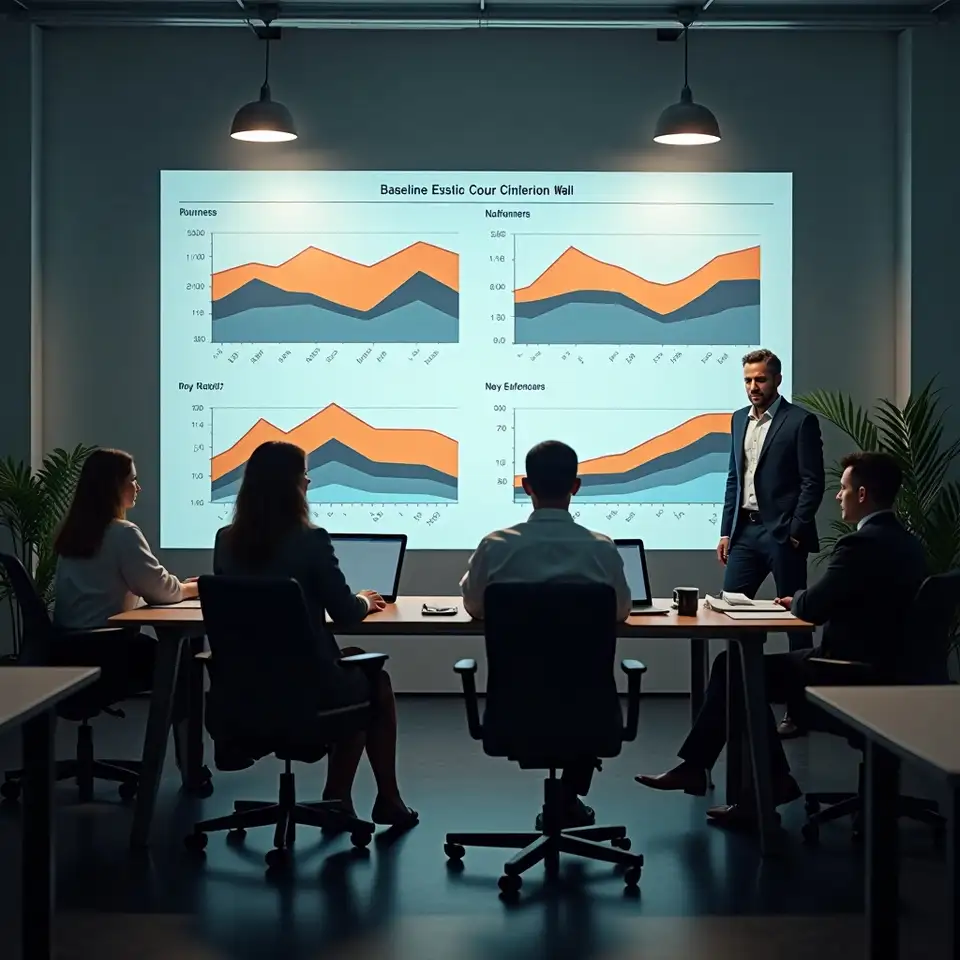
Elsewhere, a small group stands around a wall covered with printed charts and notes from Baseline to Variance Mapping. They trace coloured lines that show how key metrics drifted from the original anchors. Some lines return to the baseline after temporary shocks, while others move steadily away. The group discusses which shifts reflect deeper changes in demand or regulation across Canadian industry, and which simply mark routine volatility.

Bringing hindsight into governance
Later, during a governance meeting, a concise hindsight summary is presented
alongside current project proposals. Board members ask how lessons from the
reviewed project have shaped the new plans. The presenter points to specific
changes in monitoring, scenario design, and communication. The conversation
acknowledges that past performance does not guarantee future results, yet treats
the earlier experience as a valuable reference point rather than a verdict.

Carrying lessons into daily work
Finally, in an operations meeting on the plant floor, supervisors discuss a short note drawn from the review, highlighting early indicators to watch in their daily routines. The note is written in straightforward language and fits on a single page. It turns distant finance discussions into practical guidance for shift level decisions, reinforcing the idea that reflective practice belongs everywhere in the organisation, not only in formal reviews.
Turning reviews into a steady learning habit
Learning from past industrial finance decisions is as much about tone as it is about technique. Many teams avoid post project reviews because they fear a search for culprits or a rehearsed celebration that ignores lingering doubts. We suggest a different framing: treat each review as a structured thought experiment that asks, with humility, what the organisation now knows that it did not know then. To support this, we adapt the Three Lens Review for hindsight. Operational resilience is examined by asking how the plant or network actually coped with disruptions, not only how it was expected to behave. Capital structure is revisited through the lens of how funding arrangements felt during tight quarters, including whether covenants, repayment patterns, or internal expectations created unexpected pressure. Scenario stress is explored by comparing the original narratives of best, base, and challenging conditions with the path that unfolded. Often, reality does not match any of the neat scenarios, landing somewhere in between or outside the imagined range. This is not evidence that the original team failed. It is a reminder that industrial life in Canada remains complex and partially unpredictable. By discussing these gaps openly, and repeating that results may vary and past performance does not guarantee future results, organisations can build a culture where reflection is normal rather than exceptional. Over time, such a culture tends to produce more measured debates about new projects, because people carry a richer sense of how plans behave once they leave the slide deck.
Revisiting completed projects with disciplined hindsight
Imagine a plant upgrade completed several years ago. At the time, it promised smoother throughput, lower unit costs, and a more resilient supply chain. Today, the equipment is running, reports are filed, and the organisation has moved on to new concerns. Yet the story of that decision remains unfinished. When we revisit such projects with clients, we start by reconstructing the original narrative in plain language. What problem was the upgrade meant to address? Which constraints were considered immovable? How did teams describe success at the time, beyond the numbers in the approval deck? This reconstruction becomes the baseline for a careful comparison with what actually unfolded. Using Baseline to Variance Mapping, we trace where performance followed the expected path and where it diverged. Some differences are easily explained by timing or minor operational issues. Others reveal that a core assumption, perhaps about demand stability or supplier reliability, aged poorly. Rather than treating these divergences as failures, we explore them as clues about how your industrial environment in Canada has changed. The goal is not to rewrite history, but to extract practical guidance for future decisions: which assumptions deserve more scrutiny, which indicators should be monitored earlier, and which conversations need to involve a broader group from the outset. Results may vary, and past performance does not guarantee future results, yet this kind of disciplined hindsight often reduces the temptation to chase simplistic explanations when projects surprise you.
What reflective practice can look like
These scenes illustrate how thoughtful hindsight work can live quietly inside ordinary
meetings and documents, gradually strengthening how your organisation approaches industrial
finance decisions.